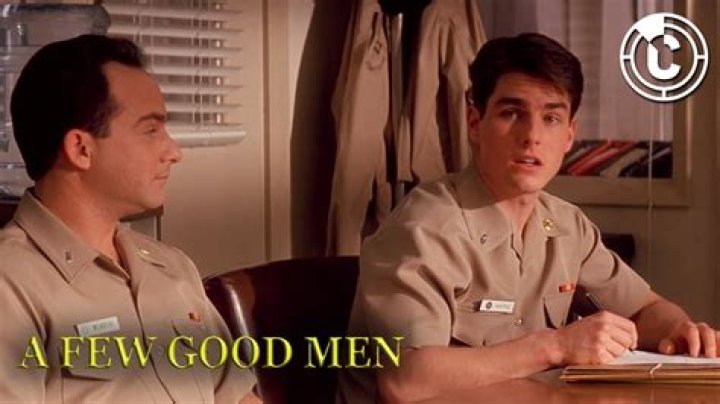

Spoilers for "A Few Good Men" follow.
One of the most dependable "Sorkinisms" rears its head repeatedly throughout "A Few Good Men" — namely, the belief in the fundamental soundness of American institutions, the failures of which can be attributed to the bad people occupying them. In this case, that belief is manifested via the downfall of Col. Nathan R. Jessup (Nicholson), the commander of the Guantanamo Bay Naval Base where the movie takes place.
Though Marine law requires all forms of punishment to be strictly legal and in accordance with due process, Jessup believes that there's nothing wrong with giving the occasional "code red" order, i.e., determining that off-the-book punishment be inflicted on soldiers so as to improve their performance. He believes that the "due process" was put in place by people who don't understand the toll of military training and that sometimes it's necessary to take shortcuts. In the movie, those shortcuts take the form of violent hazing rituals, which are depicted as being commonplace under Jessup's rule.
The death of William Santiago (Michael DeLorenzo) by one such ritual and Jessup's subsequent attempt to cover his tracks were inspired by a famous real-life case taken up by Sorkin's sister Deborah during a JAG stint. "We keep a base in Guantanamo Bay. A bunch of marines down there hazed a guy in their squad and it went bad. Something went wrong and this kid almost died. The accused are saying they were ordered to do it by a superior. Something called a Code Red," Sorkin said, quoting his sister, in an interview with ThisIsTheatre.com about the play's origins.