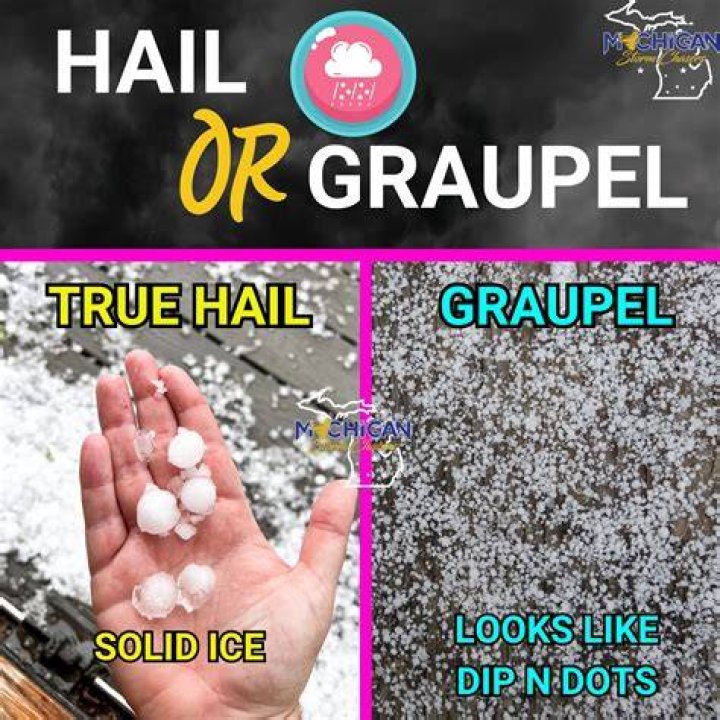

If you were out and about this afternoon you might have seen small “hail” falling. By small were talking a millimeter or two across.
If you’re asking yourself “I thought hail formed only in thunderstorms?”, you’d be correct. What fell today wasn’t hail at all, what fell is called graupel.
Below is how hail forms, there are a few other explainers further below that show how other forms of frozen precipitation form.
Ok, so that’s how hail forms, but what in the world is graupel?
Before we go too far into explaining it, in simple terms think of it as naturally occurring Dippin’ Dots! The process to make Dippin’ Dots is rather simple. The flavored & colored liquid is frozen in a cryogenic processor that cools the liquid slowly to get it below freezing but still liquid, this creates supercooled liquid. Then the supercooled liquid is flash-frozen by dropping the liquid through supercooled air (using liquid nitrogen cooled to -320ºF according to dippindots.com). As the supercooled liquid falls through the supercooled layer the droplets are flash-frozen into a soft frozen pellet. This helps to form tasty spherical “dots”, graupel isn’t perfectly spherical due to the jagged surface it forms on.
When graupel occurs, it’s similar to Dippin’ Dots but the major difference is it’s not as cold and liquid nitrogen isn’t used!
So let’s make graupel, like all precipitation we start off as snow, but some droplets had time to freeze slowly and weren’t disturbed to freeze into snowflakes. This creates liquid droplets that are at or below freezing (Supercooled liquid), eventually, the supercooled droplets come into contact with the frozen snowflake and instantly freeze onto the flake (Another similar process that occurs when rime frost forms). As more and more of the supercooled liquid hit the snowflake it grows into spiky, lumpy, pellets.
So, what makes graupel different from other forms of frozen precipitation?
Rain starts as snow but meets air that is above freezing and melts into a liquid and stays that way all the way to the ground. Freezing rain starts off just like rain but meets a small layer of air near the surface that is below freezing. This creates supercooled raindrops that freeze upon impact on most surfaces (just like what collects on snowflakes to form graupel).
Sleet is just like freezing rain, only the layer of below-freezing temperatures is larger, allowing time for the melted snowflake to refreeze again into a solid pellet. Like snow, graupel never actually melts, it’s just snow that essentially has frost form onto it.
So when graupel falls, it falls like a soft, solid, “hail” stone. When it’s windy this form of frozen precipitation will sting a little bit when hitting exposed skin but does not cause any issues for our day-to-day life.