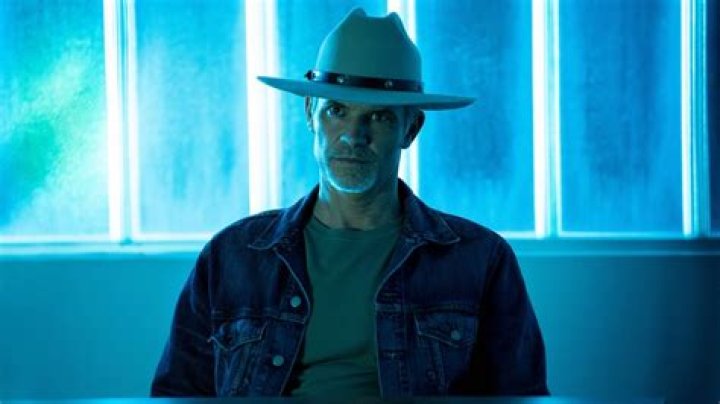

Adapted from Elmore Leonard's novel "City Primeval" (which does not, in its original form, feature Raylan Givens), the "Justified" sequel sees Raylan headed out to Detroit on a detour while traveling with his now-teenaged daughter, Willa (played by Olyphant's own daughter, Vivian). He's there ostensibly to make a brief court appearance but soon finds himself working with the Detroit Police Department on a wild and increasingly violent case. It seems that a "wildman" from Oklahoma named Clement Mansell (Boyd Holbrook) has made his way back to the Motor City, bringing chaos with him, and his path of destruction may have blown right through a corrupt local judge (Keith David), an ambitious attorney (Aunjanue Ellis), a bartender with a past (Vondie Curtis-Hall), and a local casino waitress (Adelaide Clemens) who's been trapped in the wildman's orbit for so long that she doesn't know which way is up. It's a chaotic mystery so twisty and raucous that only Raylan Givens can apparently solve it, even if it does mean broadening the rift between him and his daughter.
Right away, "City Primeval" strikes a graceful balance between the old and the new, carefully shepherded along by series masterminds (and "Justified" alums) Dave Andron and Michael Dinner, with help from many of the writers and producers who made the original show into a crime drama masterpiece. The wealth of experience on the writing, directing, and producing team, coupled with Olyphant's own ability to slip right back into Raylan's Stetson hat, means that there's an unbroken link between this show and the previous one — not just in terms of plot, but in terms of tone. It feels like "Justified" from the opening frames, and that's especially impressive because as much as the show is working to preserve the things we remember, it's also constantly breaking new ground in Raylan's story.
Yes, Raylan is instantly recognizable, and his very presence imbues "City Primeval" with the neo-Western charm that so defined "Justified," but even with that legacy in place, this is a Detroit show through and through. The warm, almost sepia hues of the Kentucky hollers are gone, replaced with the cool blues and grays of a city of steel and concrete, tinged with the neon highlights of a nightlife that could turn dangerous at any moment. Motown Records and the unmistakable tunes of the White Stripes pipe through speakers in scene after scene, while cars of every possible vintage drift through the narrative, thanks in part to Mansell's tendency to only steal vehicles that still have tape decks. It's a different flavor right away, and because it's always tinged with the familiar, it envelops us like a smooth embrace.